
|
The Becklamp
|
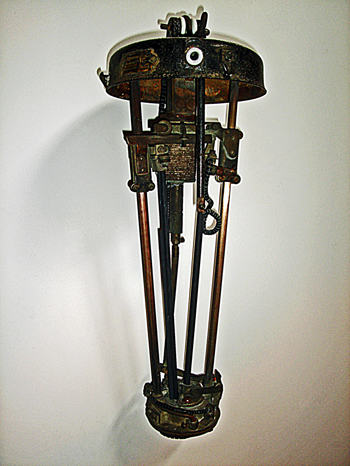
Photograph: Dr. S. Jeszensky, Electro-Technical Museum, Budapest |
The very simple and solid construction of the Becklamp model of 1907 is clarified by the following explanations and illustrations, of which the one on the left side shows an external sight of the model with installed carbons and a removed case. Until the first years of the arc lamp construction experiments, the endeavours of the inventors can be retraced to build the control mechanism for the adjustment of the correct light arc length and the feeding gear without a clockwork.
The Beck arc lamp, belonging to the group of the high-intensity carbon arc lamps with carbon pins standing next to and being inclined to each other, is manufactured in a way that the adjustment of the light arc is merely achieved by electromagnetic principles, whereas voltage changes in the mains supply don't have any effect on the lamp. (Adjustment of the current). The feeding gear takes place automatically and merely under the influence of the carbon's self-weight. The introduction of the Becklamp dates back to 1905. At that time its constructor Henry Beck succeeded to remove the mechanical imperfection of the |
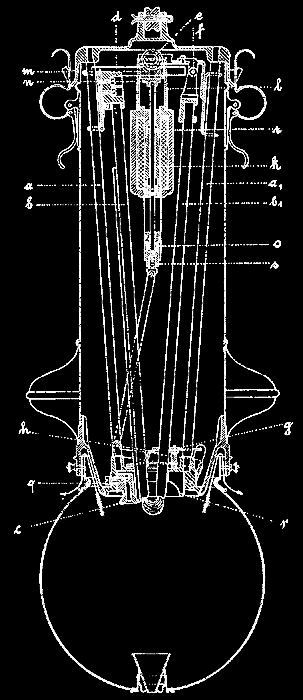 clockworkless lamp system to the extend that the construction with reference to simplicity, stability and insensitivity against rough treatment as well as the constancy of the light arc met practical demands.
The sketch on the right shows a cross-section of the lamp system. The support consists only of the two bars aa1. They connect the upper cap with the reflector and serve as slide bars for the two carbon rods bb1, which - arranged in an acute angle and influenced by their own weight and the one of the carbon holder - can glide freely downward. The profile carbon b touches a metal coating with its longitudinal rib. The round carbon b1 is joined to the rib carbon by the rail d, on which the roll e moves. The carbon holder b1 is revolvably attached on top at f. The bottom end of the carbon goes through a slider at the reflector. An auxiliary plate h of this slider leads to a seal complete as possible of the upper lamp room against the burning area. The slider g is influenced by the electromagneti in a way that - in a currentless state - the selfweight of the core k is pushing the movable carbon b1 against the rib carbon b. The electromagnet of the direct-current lamp itself is completely iron-enclosed and contains just a few coils of exclusively thick wire, which aren't in danger of burning. Above the magnet there's an air pump l, in which a graphite piston m moves. During the pulling up of the magnet core the valve disc n is put against the opening in the piston, which causes an air-tight sealing so that a very strong damping of the shift movement takes place. The downward movement at the turning off of the current takes place without any dampening, the piston and the core falling down separately, so that a possible blocking of the piston can't prevent the carbons to collide. A blockage of the piston is not very probable because the entry of gases and damps in the magnet is completely prevented by a sealing o. The pump pipe l is unscrewable by a left revolving, so that the air pump is always and easily revisable. The burning ends of the electrodes are enclosed by a two-piece fireclay reflector p that is situated in the focal spot of the lamp. The unlocking of the screw q makes it possible to take out the covering for a possible cleaning and to put it back exactly in the same position by the adjustment of the mentioned screw so that a changing of the adjustment won't happen. The fireclay reflector p is extractable after the unlocking of two screws and the removal of the covering. A sideward confinement of the light arc is achieved by a characteristic design of the supporting edge which leads to a calming of the light. The second electrode a1 is locked to the burn-up edge carbon by a chain s, which moves over two rolls p and q, so it takes part on the downward movement (left-hand sketch). This coupling enables a very smooth movement of the revolving carbon holder. In Helios, the Periodical for Elektrotechnics could found, apart from this description, the following review in the issue of September, 14th, 1904: If it is reported that the production cost of the Becklamp is uncommonly low due to its unequalled simple construction. It has to be conceded that this new arc lamp (...) means an excellent solution of the arc lamp problem. It has to be mentioned by the way that the Becklamp can be also used with common carbon pins, however the efficiency would be considerably lower than using flame carbons. The Becklamp is to be marketed before long in Germany, England and America. |